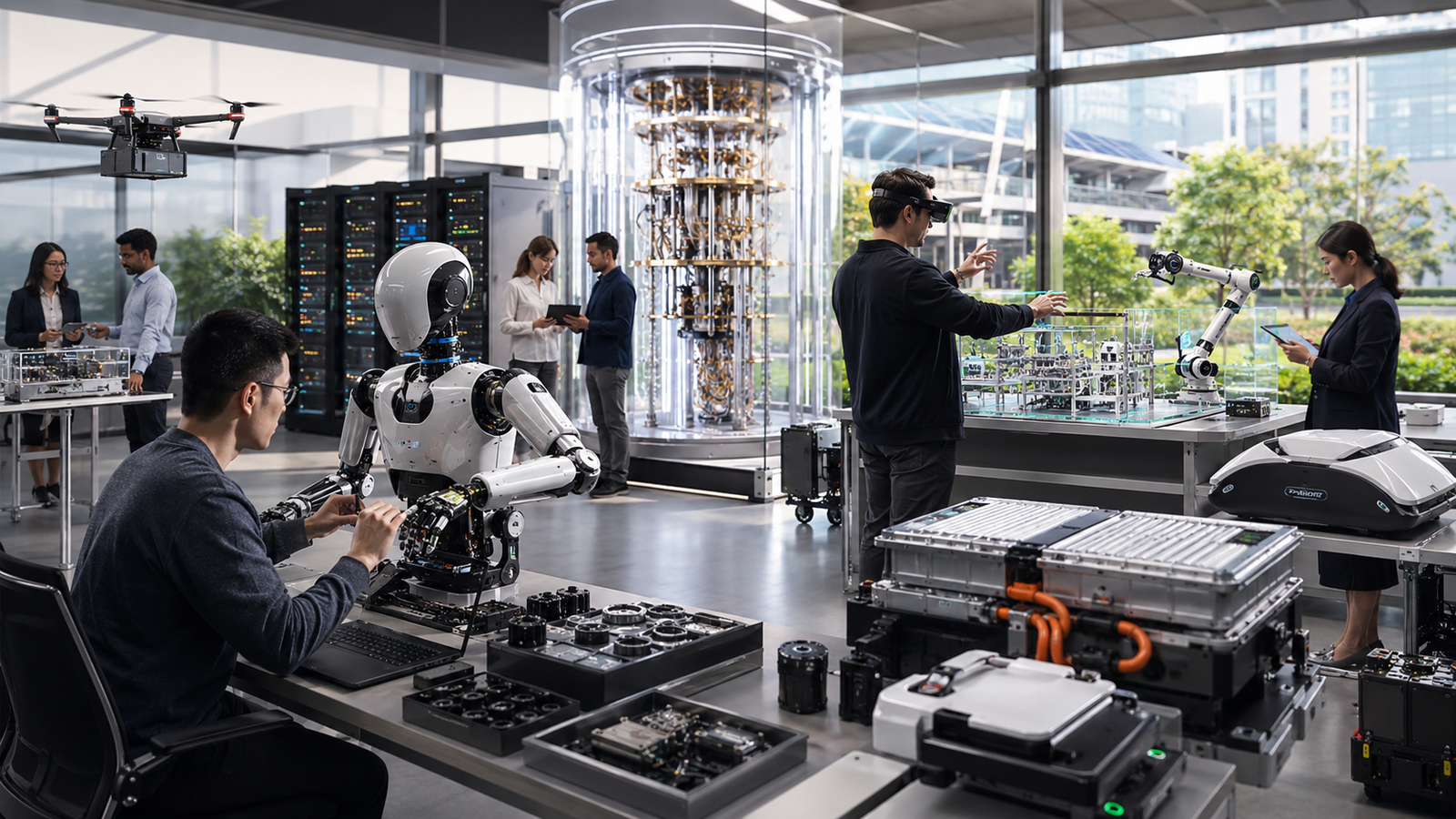
Technology continues to evolve at an extraordinary pace, transforming the way people live, work, communicate, and do business. Every year, new innovations redefine industries, improve efficiency, and create opportunities that were once considered impossible. As businesses increasingly embrace digital transformation, understanding Emerging Technologies has become essential for staying competitive in a rapidly changing world.
From artificial intelligence and quantum computing to robotics and smart cities, modern technologies are driving innovation across healthcare, finance, manufacturing, transportation, education, and countless other sectors. Organizations that invest in these advancements today will be better prepared for the opportunities and challenges of tomorrow.
This article explores the top Emerging Technologies that are expected to shape the future, explaining their benefits, practical applications, and their growing impact on businesses and society.
Why Emerging Technologies Matter
Innovation has always been a major driver of economic growth and business success. However, the speed of technological advancement has accelerated dramatically over the last decade. Businesses now rely on digital platforms, automation, cloud computing, and intelligent systems to improve productivity and customer experiences.
Emerging technologies enable organizations to streamline operations, reduce costs, improve decision-making, and develop entirely new products and services. Governments and research institutions are also investing heavily in these technologies to solve complex global challenges related to healthcare, sustainability, education, and infrastructure.
Understanding these trends allows businesses and professionals to prepare for future opportunities while adapting to evolving market demands.
1. Artificial Intelligence (AI)
Artificial Intelligence continues to lead the list of emerging technologies due to its ability to automate complex tasks and analyze massive amounts of data.
AI-powered systems help businesses improve customer service, detect fraud, personalize recommendations, automate workflows, and make data-driven decisions. Machine learning, natural language processing, and generative AI are becoming increasingly common across nearly every industry.
As AI technology advances, organizations will continue integrating intelligent automation into daily operations.
2. Quantum Computing
Quantum computing represents one of the most exciting technological breakthroughs of the decade.
Unlike traditional computers that process information using binary bits, quantum computers use quantum bits, or qubits, allowing them to solve highly complex calculations much faster.
Although still developing, quantum computing has enormous potential in scientific research, pharmaceutical development, financial modeling, cybersecurity, and logistics optimization.
3. Edge Computing
As connected devices continue increasing, processing data closer to where it is generated has become increasingly important.
Edge computing reduces latency by analyzing information locally instead of sending all data to centralized cloud servers. This approach improves application performance while reducing bandwidth usage.
Industries such as healthcare, manufacturing, autonomous vehicles, and smart cities are rapidly adopting edge computing to enable faster decision-making.
4. Internet of Things (IoT)
The Internet of Things continues connecting billions of smart devices worldwide.
Sensors, wearable devices, industrial equipment, home appliances, and connected vehicles continuously collect valuable data that organizations use to improve operations, maintenance, and customer experiences.
IoT technology supports predictive maintenance, smart agriculture, intelligent transportation, healthcare monitoring, and energy management.
5. Blockchain Technology
Blockchain has expanded well beyond cryptocurrency applications.
Today, organizations use blockchain to improve transparency, strengthen security, automate contracts, and securely manage digital transactions.
Industries including healthcare, finance, supply chain management, and government services increasingly rely on blockchain to enhance trust and reduce fraud.
6. Cloud Computing
It remains one of the most influential emerging technologies supporting digital transformation.
Cloud platforms provide scalable infrastructure, flexible storage, advanced analytics, disaster recovery, and global accessibility without requiring organizations to maintain expensive physical hardware.
Businesses continue migrating applications and workloads to the cloud to improve efficiency and scalability.
7. Robotics and Intelligent Automation
Modern robotics has evolved far beyond manufacturing assembly lines.
Intelligent robots now assist in healthcare, logistics, retail, agriculture, warehouses, and hazardous industrial environments.
Combined with artificial intelligence, robotics enables organizations to automate repetitive tasks while improving productivity, accuracy, and workplace safety.
8. Extended Reality (XR)
Extended Reality combines Virtual Reality (VR), Augmented Reality (AR), and Mixed Reality (MR).
Businesses use XR technologies for employee training, product design, healthcare simulations, education, entertainment, and customer engagement.
As hardware becomes more affordable, immersive technologies are expected to become increasingly common in both consumer and enterprise applications.
9. 5G and Next-Generation Connectivity
High-speed wireless connectivity is enabling entirely new digital experiences.
5G networks provide faster internet speeds, lower latency, and greater reliability, supporting technologies such as autonomous vehicles, remote healthcare, industrial automation, and smart cities.
Improved connectivity also strengthens cloud computing, IoT, and mobile applications.
10. Cybersecurity Innovation
As digital transformation accelerates, cybersecurity continues evolving alongside emerging technologies.
Organizations increasingly rely on AI-powered threat detection, Zero Trust security models, behavioral analytics, multi-factor authentication, and automated incident response to protect critical systems from sophisticated cyber threats.
Security innovation remains essential for ensuring trust in modern digital environments.
Benefits of Emerging Technologies
Organizations adopting emerging technologies gain numerous competitive advantages.
Some of the most significant benefits include:
- Improved operational efficiency
- Faster decision-making
- Enhanced customer experiences
- Reduced operational costs
- Increased business agility
- Better data-driven insights
- Greater innovation opportunities
- Improved cybersecurity capabilities
- Scalable digital infrastructure
- Long-term business growth
Businesses that embrace innovation are better positioned to compete in an increasingly digital economy.
Challenges of Adopting Emerging Technologies
Although the opportunities are significant, implementing emerging technologies also presents several challenges.
Organizations frequently encounter issues related to high implementation costs, cybersecurity risks, integration complexity, workforce training, regulatory compliance, and resistance to organizational change.
Successful adoption requires careful planning, ongoing investment, and continuous employee education to maximize long-term value.
The Future of Emerging Technologies
The pace of technological innovation shows no signs of slowing. Artificial intelligence will become more intelligent, quantum computing will solve increasingly complex problems, and connected devices will continue generating unprecedented volumes of data.
Businesses will rely more heavily on automation, cloud infrastructure, intelligent analytics, robotics, and immersive technologies to improve efficiency and remain competitive.
Organizations that continuously monitor technological advancements and invest strategically will be better prepared for future disruption while creating new opportunities for growth and innovation.
To explore the latest research and insights on emerging technologies, visit the World Economic Forum – Technology and Innovation.
