Deploying large language model (LLM) applications in enterprise settings is no longer a research experiment — it’s an operational challenge that demands architectural rigor, security discipline, and cost awareness from day one.
1. Understand the Unique Challenges of Enterprise LLM Deployment
Unlike traditional software deployments, LLM-driven applications carry a distinct set of operational risks. Models are large, inference is compute-intensive, and outputs are probabilistic — meaning the same input can produce different results. Before writing a single line of infrastructure-as-code, teams must map out their latency requirements, expected throughput, compliance boundaries, and acceptable failure modes.
Enterprise environments also introduce organizational friction: existing IT governance, data residency regulations, and procurement cycles can slow down experimentation. A phased approach — starting with a controlled proof of concept and gradually scaling — tends to outperform big-bang deployments in real-world settings.
2. Choose the Right Cloud Infrastructure
The three major cloud providers — AWS, Microsoft Azure, and Google Cloud — each offer managed LLM services (Bedrock, Azure OpenAI Service, and Vertex AI respectively). Choosing between a fully managed API, a self-hosted open-source model, or a hybrid approach depends on your data sensitivity, customization needs, and budget.
Pro Tip: If your organization handles regulated data (HIPAA, GDPR, financial PII), prefer a self-hosted or private cloud deployment of an open-weight model like Llama 3 or Mistral over sending data to a third-party API endpoint.
GPU availability is the most common bottleneck. Reserve GPU instances (A100s, H100s) in advance for production workloads. For inference-only deployments, consider spot instances with fallback logic to manage costs. GPU orchestration platforms like Kubernetes with NVIDIA GPU operators streamline pod scheduling across heterogeneous clusters.
3. Design a Scalable Inference Pipeline
A production-grade LLM inference pipeline typically includes a load balancer, an API gateway with rate limiting and authentication, a model serving layer (such as vLLM, TGI, or Triton Inference Server), and optionally a semantic caching layer. Semantic caches like GPTCache significantly reduce redundant API calls by returning stored responses for semantically similar queries, cutting both latency and cost dramatically.
- Deploy model servers behind an autoscaling group tied to request queue depth
- Use streaming responses (SSE or WebSocket) to improve perceived latency
- Implement request batching to maximize GPU throughput during high-traffic windows
- Add a fallback model (smaller, faster) for non-critical requests during peak load
4. Integrate RAG for Enterprise Knowledge
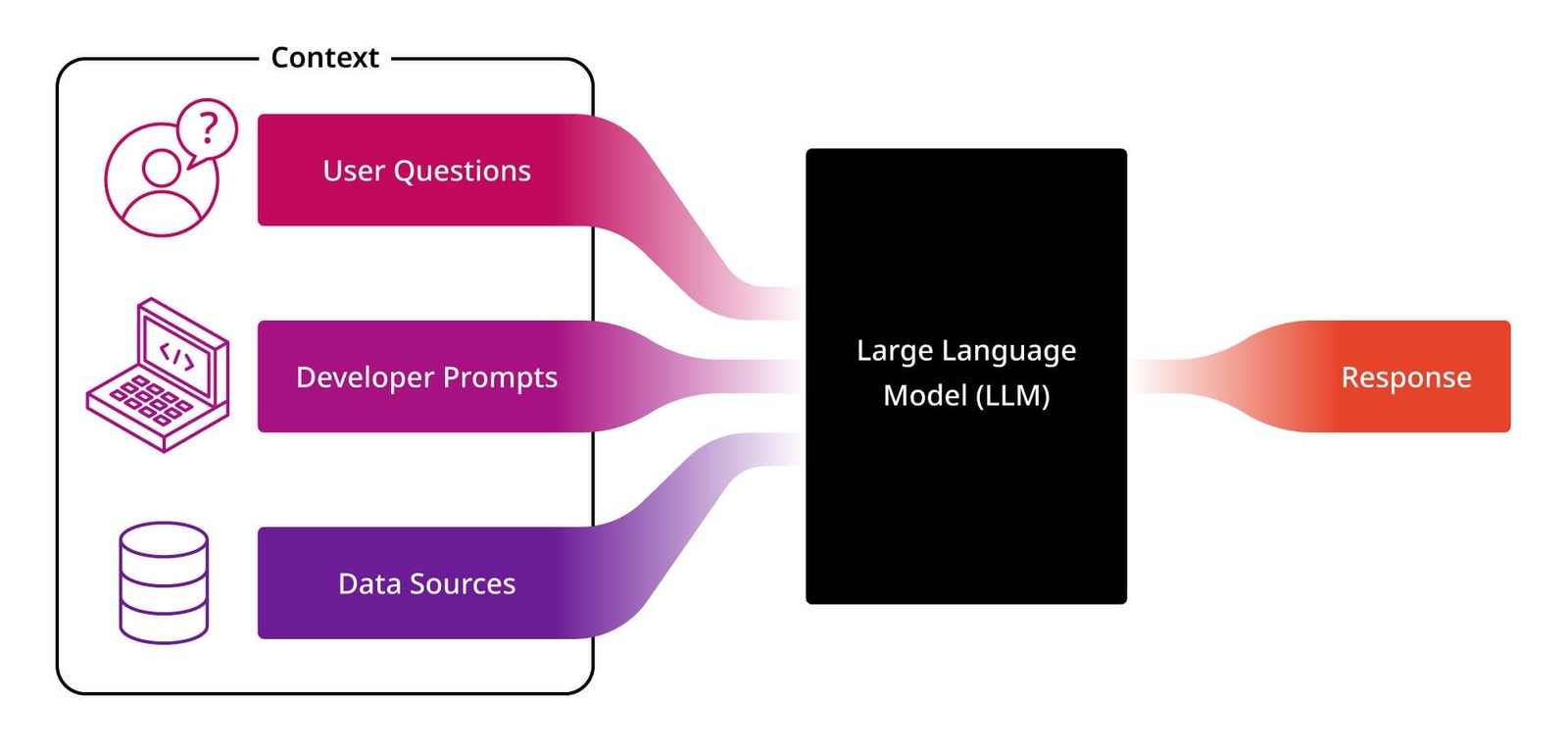
Retrieval-Augmented Generation (RAG) is the dominant pattern for grounding LLM responses in company-specific knowledge. Rather than fine-tuning a model on proprietary data (expensive and time-consuming), RAG retrieves relevant documents at query time from a vector database such as Pinecone, Weaviate, or pgvector, then passes them to the LLM as context.
For enterprise deployments, the document ingestion pipeline is as critical as the retrieval itself. Ensure your chunking strategy, embedding model, and metadata filtering are tuned for your domain. A poorly chunked knowledge base produces hallucinated or incomplete answers regardless of the model’s quality.
5. Security, Compliance, and Guardrails
Security is non-negotiable in enterprise contexts. Every layer of the stack needs hardening: network-level isolation (VPCs, private endpoints), identity and access management (IAM roles, API key rotation), and output guardrails to prevent the model from generating harmful, biased, or policy-violating content. Tools like NVIDIA NeMo Guardrails, Guardrails AI, and custom prompt injection filters should be embedded directly into the inference path.
For regulated industries, maintain an audit trail of all model inputs and outputs. Log redaction of PII before storage is mandatory in most compliance frameworks. Map your deployment against SOC 2, ISO 27001, or sector-specific requirements before going live.
6. MLOps, Monitoring, and Continuous Improvement
Deploying an LLM is not a one-time event. Models drift, user patterns shift, and prompt engineering optimizations accumulate over time. A mature MLOps practice for LLMs includes automated evaluations (LLM-as-judge, human preference scoring), latency and token consumption dashboards, error-rate alerting, and a structured process for rolling out prompt or model updates without downtime.
Key Metric to Track: Time-to-first-token (TTFT) and tokens-per-second (TPS) matter more than overall response time for streaming applications. Set SLO targets for both separately and alert on either degrading independently.
7. Cost Optimization Strategies
LLM inference costs can escalate quickly at enterprise scale. The most effective levers are model right-sizing (using a smaller model for simpler tasks), prompt compression (reducing input token counts), aggressive caching, and batching. Consider a tiered routing strategy: classify incoming requests by complexity and route straightforward queries to cheaper, faster models while reserving premium models for high-value, complex tasks.
Key Takeaways
Successful enterprise LLM deployment is a systems engineering problem, not just a model selection problem. Start with a clear infrastructure blueprint, enforce security from day one, build for observability, and treat your deployment as a living system that requires ongoing tuning. Organizations that invest in this foundation see significantly faster time-to-value and lower total cost of ownership than those who bolt on these concerns after launch.
